use role content_dbt_prod;
use schema content.content_prod;
alter table content.content_prod.place rename to place_hco;
create view content.content_prod.place as select * from content.content_prod.place_spark;
Content Squad announcement:
Old content.content_prod.place table (HCO-based) has been renamed and considered private
In this week's newsletter, Anthropic included this:
"My daily driver currently looks like: two lead agents that keep each
other accountable and restart the other if either fails. These
delegate to tech lead or PM agents for the 8-10 projects I'm running
at any one time, and each project has 5-10 IC [individual contributor]
agents, generalists or specialists depending on the problem. Across
all of these I'm still only doing 30-50 prompts per day, and my IC
agents typically work autonomously for 2-3 days. About 60% of my
interaction is with the leads, 35% with a project lead, and 5% is when
something has gone off the rails. All of these agents communicate
directly with the SendMessage tool."
                                      ╭─ keep each other accountable
                   ╭─ two lead agents ┼─ restart the other if either fails
                   │                  ╰─ delegate to ┬─ tech lead ── 8-10 projects...
                   │                                 ╰─ PM agents
                   │                                                 ╭─ . ┬─ generalists
« Daisy workflow » ┼─ 8-10 projects ── per project ── 5-10 IC agents ┤    ╰─ specialists
                   │                                                 ╰─ work autonomously ── for 2-3 days
                   │                        ╭─ 60% with leads
                   ├─ 30-50 prompts per day ┼─ 35% with project lead
                   │                        ╰─ 5% off rails
                   ╰─ agents communicate ── SendMessage tool
My thoughts:
Why two lead agents? Likely they both run "/loop 30m check projects"
with offset, so one is checking status while another is ready for
communication. This is where "60% with leads" coming from; sometimes
they both are checking, and Daisy goes to project leads directly. Those two
leads have permanent session names and never closing.
8-10 projects. I also have about the same number of big topics a
week, often carried to other weeks. So this sounds like the right
amount of parallelism. Also keeping 8-10 projects on track is within
cognitive abilities of an average human.
                                          ╭─ Slack
                 ╭─ where work comes from ┼─ CI/CD ── no point to fix CI/CD manually
                 │                        ├─ Dashboards
                 │                        ╰─ Internal Docs
                 ├─ tip ── try doing ALL work from within CC
                 │         ╭─ code conventions are not in the model
                 ├─ limits ┼─ fine-tuning doesn't work well ── leads to more hallucinations
                 │         ╰─ in-context learning ── ICL ── general AI wins over specific AIs
                 │                                                         ╭─ rigid templates
                 │                     ╭─ compensates lack of intelligence ┼─ guardrails
                 │                     │                                   ├─ "don't let it touch X"
                 ├─ two kinds of tools ┤                                   ╰─ gets less useful as model improves
                 │                     │                           ╭─ more access
                 │                     ╰─ scales with intelligence ┼─ more control
                 │                                                 ├─ faster feedback loops
                 │                                                 ╰─ gets more useful as model improves
                 │                          ╭─ context window stayed at 1M max ── models are way better yoy
                 │                          ├─ can't dump the whole X into context ── X ┬─ wiki
                 ├─ context window is a box ┤                                           ╰─ codebase
                 │                          ├─ example ── try to run npm on Arduino
                 │                          ╰─ don't pay for what you don't use ── [TK: no slop skills]
                 │           ╭─ cached tokens are cheap ── new are expensive
                 │           ├─ not an LRU problem
                 ├─ KV cache ┼─ change in early instructions invalidates the cache ┬─ add new tool
                 │           │                                                     ╰─ change in CLAUDE.md
                 │           ╰─ put stable stuff at the front ── volatile at the end ── CC teams tries to solve this problem
                 ├─ Large-scale Software Engineering ── main question ── Does it scale?
                 │                           ╭─ when it's the right tool?
                 │                           ├─ CC has a shell ── Skill+CLI has less overhead
                 │                           │                                 ╭─ name
                 │                    ╭─ MCP ┼─ tools definitions sit in front ┼─ arguments
                 │                    │      │                                 ╰─ description
« Agentic flow » ┤                    │      │              ╭─ puts just name in the system prompt
                 │                    │      ╰─ tool search ┼─ kind-of lazy-loaded
                 │                    │                     ╰─ needs to be very specific ── e.g. slack
                 │                    │         ╭─ in-context
                 │                    │         ├─ one-line description always loaded
                 │                    │         ├─ full SKILL.md and assets loaded on-demand
                 ├─ Plugin primitives ┼─ Skills ┤                 ╭─ body is pay-per-use ── good
                 │                    │         ╰─ does it scale? ┼─ reliably loading requires a paragraph in description
                 │                    │                           ╰─ not possible to lazy-load sub-skills ┬─ no hierarchy yet
                 │                    │                                                                   ╰─ what if 100k skills?
                 │                    ├─ Hooks ┬─ runs code on events ── shell scripts
                 │                    │        ╰─ zero-overhead abstraction
                 │                    │         ╭─ out-of-context ── fundamental difference to a skill
                 │                    │         │               ╭─ named role
                 │                    │         ├─ more Claudes ┼─ own system prompt
                 │                    ╰─ Agents ┤               ╰─ own tool set
                 │                              ├─ spawned with a task ┬─ returns result
                 │                              │                      ╰─ its transcript doesn't come back
                 │                              ╰─ description still in-context ── what if 100k agents?
                 │                             ╭─ loads fully unconditionally ┬─ doesn't scale
                 │                ╭─ CLAUDE.md ┤                              ╰─ every plugin adds it
                 ├─ Doesn't scale ┤            ╰─ better inject via SessionStart hook
                 │                │         ╭─ low-quality ── low-cost ── useful, different contract
                 │                ╰─ Memory ┼─ model-curated, not human-curated
                 │                          ╰─ plugins are human-authored, human-reviewed
                 │                 ╭─ worktrees ┬─ one repo ── N claudes each owns its branch
                 │                 │            ╰─ better make it long-lived ── less overhead ── [TK: try kunchenguid/treehouse?]
                 ├─ Multi-clauding ┼─ asynchrony ┬─ walk away, let it do the work
                 │                 │             ╰─ /loop 10m
                 │                 ├─ parallelism ── multiple of asynchrony
                 │                 ╰─ lot's of context switching
                 ╰─ Agent-teams ┬─ teammates ── long-lived ── unlike agents
                                ╰─ SendMessage tool ── Claude's talking to each other
Let's see if I'm going to use it, if yes – will think about publishing
a release. If you want to build it – clone the repo and ask Claude
Code to build it.
☑ Internal Org Roam links are pasted as markdown files. So in theory,
I could somehow expose them.
I ended up forking it to https://github.com/velppa/textpod and greatly
improving it for my needs. You're reading notes served by Textpod
v0.2.0. It is my project.
Notable changes:
Read-only mode with token authentication: The app now supports an
optional --token flag that enables authentication. When a token is
set, users without the token see a read-only interface where they
can only search notes. Access is granted via a ?token=X query
parameter (which sets a cookie) or a Bearer token in the
Authorization header. The UI dynamically adjusts based on
authentication status, hiding edit/delete controls and changing the
editor placeholder for unauthenticated users.
Enhanced note management: Notes now have unique IDs based on
timestamps, enabling direct access via /note/:id URLs. PUT method
allows editing notes (upserting if not found).
Subpath support: to deploy on your domain under subpath, supply
--base-path notes flag. Then notes will be under /notes subpath.
The app watches the notes file for external changes and
automatically reloads.
The link archiving feature lets users prefix URLs with + to both raw
urls and Markdown-formatted.
Special handling of links to .md files: They appear when exporting
from Org-roam. These are internal links and Textpod now turns them
into search by filename, effectively returning all mentions of this
concept. Poor man zettelkasten import.
UI improvement: larger fonts, footer, better code snippets for
dark mode, tags on the heading.
textpod.el: Companion Emacs package for quick sending notes to
Textpod.
Later changes to setup will go into separate notes.
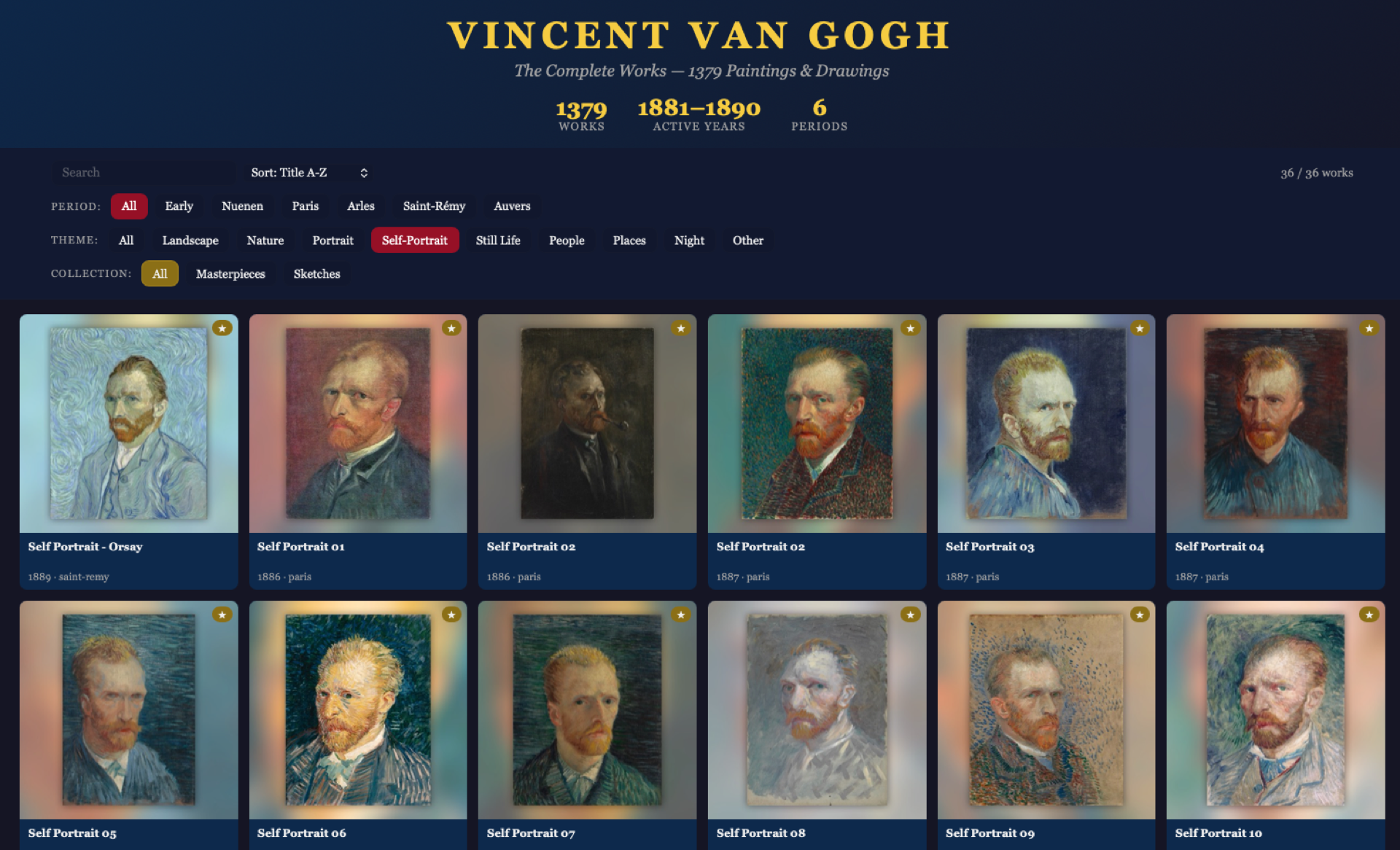
Vincent Van Gogh gallery
I found on my external drive a collection of Vincent Van Gogh
paintings, that I converted into desktop wallpapers using
Backgroundifier app (archagon/backgroundifier-public) several years
ago.
The collection is pretty big, 1380 paintings. To explore it in a
better way than just going through files on a disk, I built an
interactive gallery (a small project using Claude Code). It serves
images directly from my external drive; also had to prepare thumbnails
for faster loading.